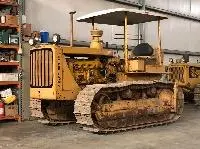

Hello All. I'm a new member to ACMOC and am fulfilling a long time bucket list item by aquiring a D2, 5U5164. The fuel tank has taken a number of hits and it's my hope to restore it at some point. I've poured over the pictures in a previous post by Old_n_slo, who did a great job of cutting the back out, repairing it and welding it back in. My questions are these. My tank currently has fuel in it. After emptying it, what is the safest method to insure there is no risk of fire or explosion while cutting out the back panel to be repaired as well as when welding the panel back in. And, has anyone have alternate methods for repair such as stud welders/hammer pulling, etc.? Thanks for any input, this forum has already been a wealth of information to read. I won't get the D2 until spring when the weather eases up in upstate NY. Thanks! Chris
I’ve drained mine and steam cleaned 3x after giving it a good flushing. I don’t worry too much about diesel tanks and have never touched a gasoline tank. Keep proper safety gear close by in case something strange happens.
Is yours severely damaged? I ask because some folks are just looking at cosmetic repairs I.e., body filler to smooth the back side.
Juiceman. Its banged in with enough depression in spots that it would be a measurable amount of filler to fair it out. With multiple coats of stranded fiber filler it may work. I'd would prefer not to cut and reweld if I can be creative with another solution. The tank has fuel and looks pretty clean inside. All opinions are welcome.
Well, okay…you could drain the tank etc. and block off the ports; a rubber tip air nozzle into the vent hole of the fuel cap, you can try “popping” the dents out instead of all of the welding, cutting etc. I had a plugged line in one of mine and we ended up making the tank bulge. I knocked it back into shape with a 4# sledgomatic and block of wood. That might be enough to warrant body filler. JM
JM, that's a really interesting idea on the compressed air use. Perhaps even if I warmed up skin of the tank slightly for some flex and just slowly introduced air pressure to watch for movement. Then adjusting back close as you suggested with the 4# helper. After that some good old-fashioned bodywork and blocking may just do it. Thanks for the input!
For two stroke exhaust pipes, I make a plug for both ands and thread one for an air fitting. Pressurize to around 20-25 psi, then take a rosebud tip on an oxy/acetylene to warm the dent. Start slowly working in a circle, from the outside edge of the dent. Generally once the metal is warm enough, you will see it starting to walk outward. Keep in mind, the dent may have stretched the metal and as such, it can be a bit more work to try to “shrink” it or perhaps get it close and use lead or body filler to make it smooth. (Since it isn’t exposed to the same heat and vibration frequency) Your air pressure and BTUs may need to be a little higher, as the tanks are thicker than race pipes.
D5C, D4-7U, D2-5U, D2-5J
Thanks B!
Hi, Ccafer.
There is also a little 'trick' that some dent removal specialists for cars and trucks use where they put a suction cup over the dent and exhaust the air inside the cup to pull the dent out - may take a little more 'robust' approach with something as heavy as your fuel tank but can't see why it wouldn't work.
Just my 0.02.
You have a wonderful day. Best wishes. Deas Plant.
Way back when machines came down under as deck cargo it was common to have dented panels and tank backs.
If the dents weren't too bad some local panel beaters would body fill the dents, or the welders would weld a new skin over the dented one.
If said dents were really bad so as to be an issue with the amount of fuel capacity loss then the welders would grind and/or gouge off the old skin and weld in a replacement that they cut to suit.
We used to use our steam cleaner to scour out said tanks before doing any cutting or welding.
The wharfies used to keep use employed doing insurance repairs on new machines in the 1960's & 70's before roll on roll off vessels.
Cheers,
Eddie B.
Thanks for the inputs. Sadly I see so many tanks out there where the operator wasn't looking rearward I guess. Perhaps it will be a combination of techniques. I can cut and weld but being a fuel tank gives me pause and if I can get close results with some metal management then apply some body work strategy that gets close enough i'll be happy. Which for me is flat so I suspect I've got my work cut out for me, (no pun intended). This is a great information forum. Thanks for the insights! Chris
Hi, Folks.
For what it is worth, I once welded up a punctured fuel tank inna Ford Cortina GT sedan by running a car exhaust into the tank for about 15 minutes before I started welding with oxy/acetylene and black wire rods. I kept the exhaust flowing into the tank during the entire welding process.
The exhaust gases supposedly reduced the amount of available oxygen and fuel below the levels required for combustion/explosion. I did take the tank out and place it on the ground well away from anything else before doing this, just in case.
NOT a recommended procedure but when you're 150 miles from anywhere and 300 miles beyond the Black Stump, - - - - - - - - - - . And the nearest Ford dealer is 400 miles away.
A diesel exhaust would be much safer due to the absence of any petrol/gasoline fumes with their correspondingly more dangerous flash point. here izza link to a list of flash points for various substances:
https://www.engineeringtoolbox.com/flash-point-fuels-d_937.html
PLEASE note that the flash point for gasoline is MINUS 45 degrees fahrenheit. The flash points for diesel fuels are all 100 deg, F, or above.
Just my 0.02.
You have a wonderful day. Best wishes. Deas Plant.


Our channel highlights machines from the earliest Holt and Best track-type tractors, equipment from the start of Caterpillar in 1925, up to units built in the mid-1960s.
Antique Caterpillar
Machinery Owners Club
1115 Madison St NE # 1117
Salem, OR 97301
Terms & Privacy
Website developed by
AdCo
"I became a member recently because the wealth of knowledge here is priceless."
-Chris R