

I take it that it's the same governor, Eddie?
basically but, the centre control shaft is overhung and supported in the cap of the early bump cover ones--the later units it seems the control shaft is shortened at the cap end and so does not need the bump cap to support its end--newer flat cover types would be easier to make and would not suffer control shaft alignment issues resulting in sticking in said end cover bush. Resistance to movement of the shaft in the cap due to oil drag and suction/pressure issues with the shaft moving back and forth in the end cap as I cannot recall if there is a relief passage drilled in the end cap.
In cold weather I could see the early bump cap Gov's being sluggish in operation.
Cheers,
Eddie B.
Well done Eddie I am too busy or too lazy to search but I did remember seeing it and top up whenever I have a govenor removed. Father Caterpillar could have made it more conveniet. cheers WF
found scans in my files of both early and late pony governors.
Cheers,
Eddie B.
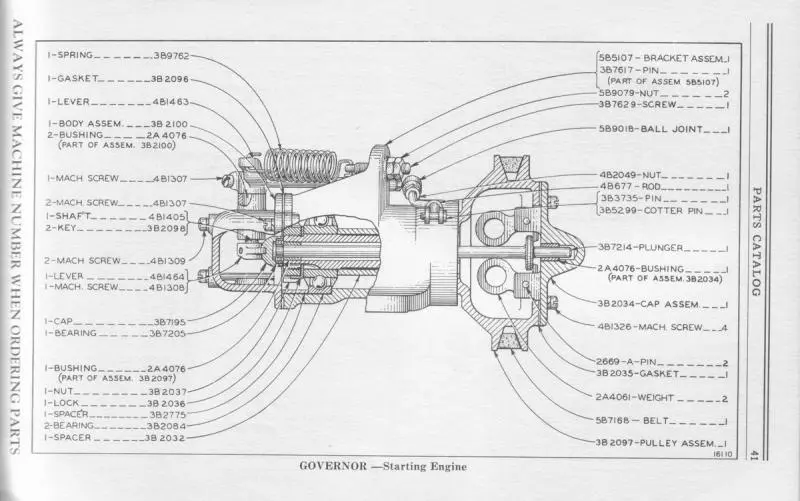
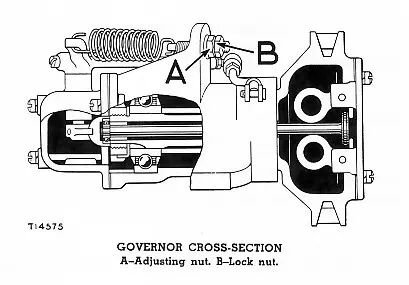
You know one thing I've wondered is why the guidance is two teaspoons of oil, because it seems to me that that would be insufficient to reach the bearings at the opposite end to the pulley. Under speed, those two teaspoons would spread out in the pulley cavity and none of it would reach the other end. Perhaps the engineers assumed that at some point, the tractor would be on enough of an angle that some would drain to the other end. But consider the scenario where the tractor is on a downward slope, parked for months. All the oil drains from the bearing end. Then the owner starts the pony and the oil spreads out in the pulley cavity with none of it running to the other end. And the pony runs for many minutes, with those bearings running dry. Just seems a bit off, design-wise. Comments?
I said above that it is 2 TABLESPOONS full of oil for the later style Gov. as directed in the instructions in the relevant engine SRB (Servicemen's Reference Book)
The early bump cap units was until oil ran out of the end cap lower screw with the unit i horizontal or if you like held in its working orientation.
Eddie B.
Thanks Eddie.
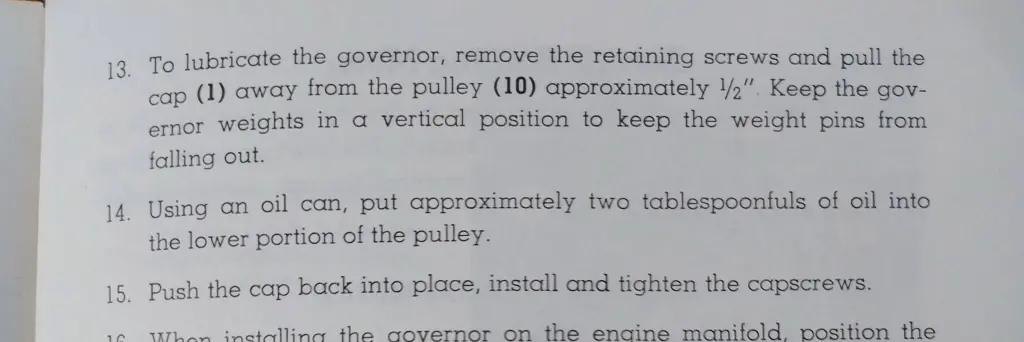
I was sure I'd looked through the SRB carefully. Obviously not. This is from D315 book.
This is from D318 SRB.
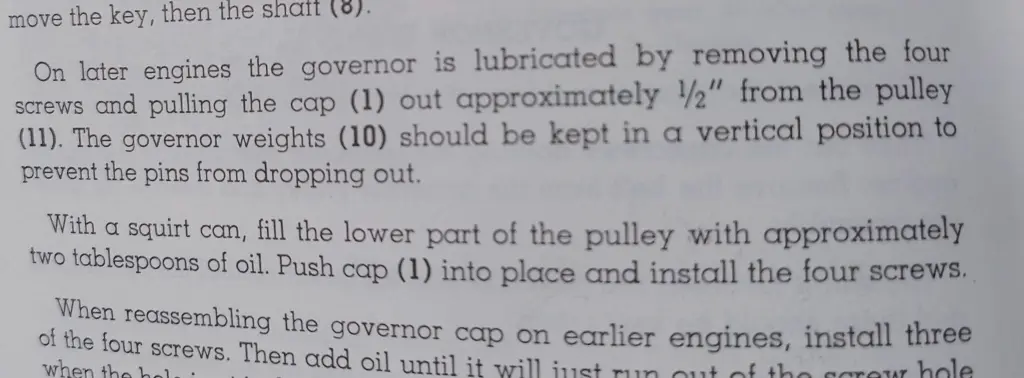
Paul.


Our channel highlights machines from the earliest Holt and Best track-type tractors, equipment from the start of Caterpillar in 1925, up to units built in the mid-1960s.
Antique Caterpillar
Machinery Owners Club
1115 Madison St NE # 1117
Salem, OR 97301
Terms & Privacy
Website developed by
AdCo
"I also joined a year ago. had been on here a couple of times as a non-member and found the info very helpful so I got a one year subscription (not very expensive at all) to try it out. I really like all the resources on here so I just got a three year. I think its a very small price for what you can get out of this site."
-Jason N