

My D2 hasn't been used much in the last year, but it sits under cover in a shed. The fuel tank has always been clean. I went to fire it up for a project, and this is what the fuel tank looks like under the cap. The fuel is probably 2 years old, and I always add some Standyne stuff for lubricity. I use regular gas station diesel (upstate NY). She fired up and ran fine, and I completed a project with an hour or two running. Should I be expecting the fuel filters to plug up soon? What is this junk? Should I just ignore it and run it, or do I need to do something more drastic?
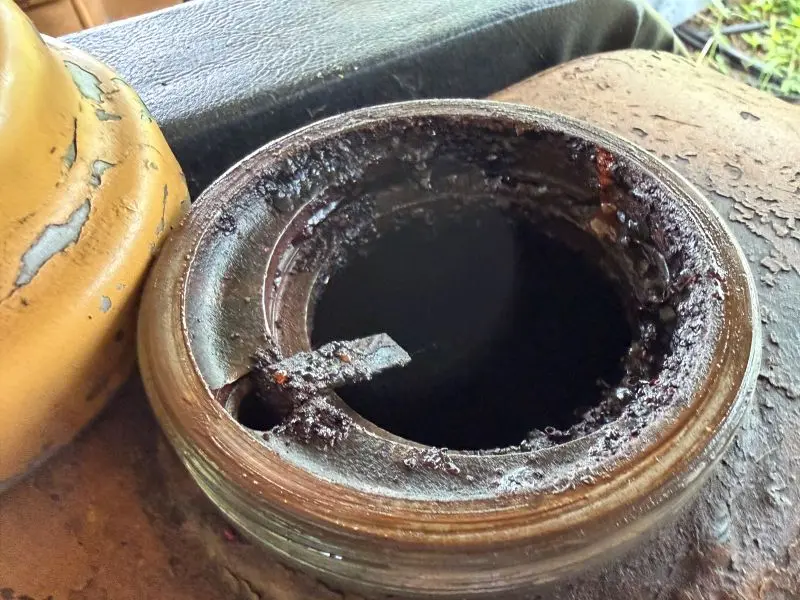
Looks like rust. We have plenty of humidity in NY, even when stored under a roof and I'd guess that tank's more empty than full. I'm in Western NY and our machines always look like that because they're rarely used hobby machines (U-series)
Hi CatD2,
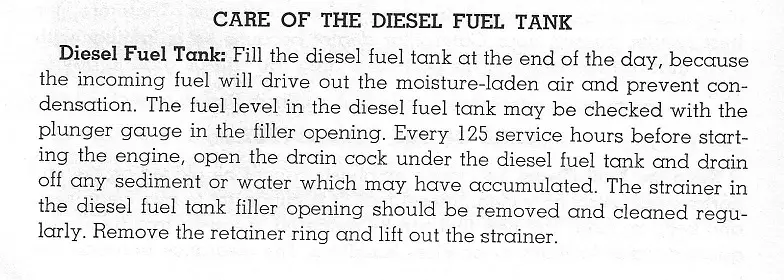
as Neil said it looks like rust and the result of moisture laden air breathing in and out of the tank during temperature changes causing condensation within the tank. Scan below is from an OMI on the care of said tanks and reasons to refill them at the end of the working day.
Cheers,
Eddie B.
So you don't think it has anything to do with algae growth or something like that? That was what I was worried about. Rust around the cap area makes sense. Over the years I was usually more careful to keep the tank full during storage. I'll clean the area up as best I can without letting any junk fall into the tank, and make sure to keep the tank topped off. Seeing that, now I am considering putting a small fuel filter in the feed line to capture anything prior to entering the transfer pump. Even a small filter would prevent any rust particles prior to the main filters.
HI CatD2, I added a filter / sediment bowl combination just before the transfer pump, both to catch crud like you mentioned, but also to reduce the frequency of having to change the main filter elements
Maybe it is old age just making me a pessimist. Modern diesel fuel is different than years ago. A injection pump rebuilder by trade talks of new issues such as the rotary pumps freezing up with new ultra low sulfur fuel that never happened in the old days. I have no idea if any additives would do much.
I do believe fuel from the 60's to 90's can be good to use yet. If it smells good have used some of that fuel with no issues caused by it.
So filling the tank on a hobby machine that may take more than 5 years to empty ??? But the worst case of rust in a fuel tank I have seen was from a machine sitting in a barn in an area with 8-10 inch average rain fall. It had been sitting inside since 1985 and USA government farm land retirement program. It had been taken out one day a year to make some fire breaks. One spring the one steering clutch was stuck, and did not free up in that days use. Sat until the barn started falling down. Sometime between 2010 and 15 it was offered to me. It started very easy, hopefully a engine with modern fuel will do that.
Thanks everyone for the insights and discussion. While on the general subject, does anyone use particular additives to their fuel to help improve lubricity and perhaps to reduce the chance of algae growth for bio-fuel blends? I always put some Stanidyne (sp?) in the tank, but I have no idea if it really helps or not. I imagine the older injector designs need more lubricity than the modern low sulfur fuels provide. I don't know if modern diesel fuel at the pump (in the US and NY at least) is part bio- or not. I know our home fuel oil is I think, B20, but the gas station pumps don't list any "B" percentage. Not like the old days of just backing up to the fuel oil tank and pumping some in at $0.10/gallon.
I haven't in any my units and haven't had any issues but then, other than my mower with a 3 cyl Yanmar in it, nothing else does the hours. I used to run my 6.0 F350 on B10 but in the end, it wasn't worth the drive to where that gas station was. I've heard folks say add something for the lubricity but again it probably only matters if the hours are piling on. Still, pretty easy to tip some two-stroke oil or ATF into the tank


Our channel highlights machines from the earliest Holt and Best track-type tractors, equipment from the start of Caterpillar in 1925, up to units built in the mid-1960s.
Antique Caterpillar
Machinery Owners Club
1115 Madison St NE # 1117
Salem, OR 97301
Terms & Privacy
Website developed by
AdCo
"I became a member recently because the wealth of knowledge here is priceless."
-Chris R