

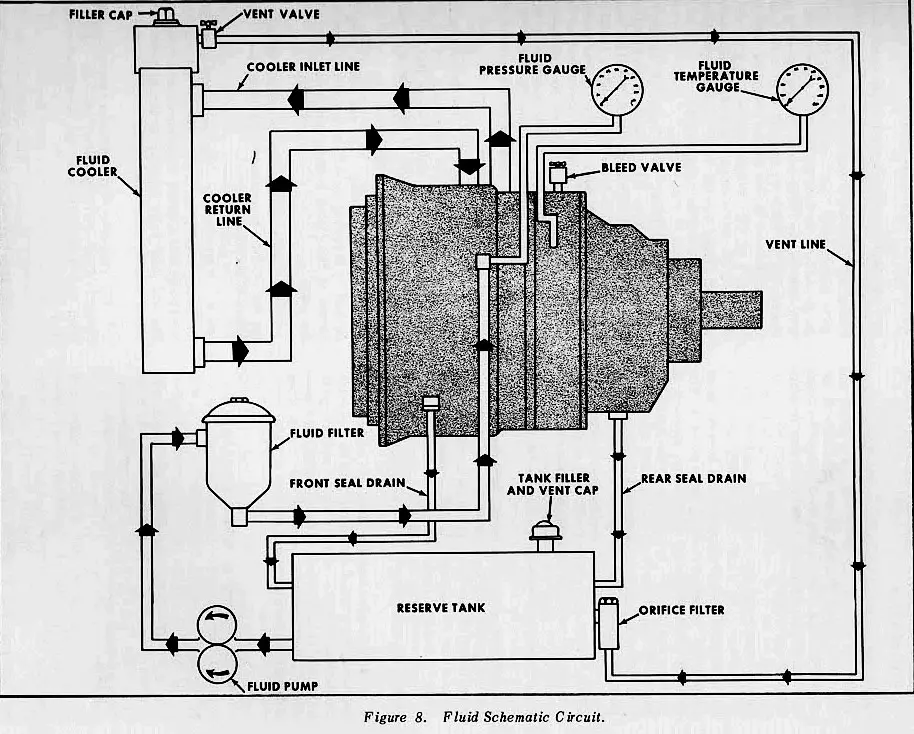
Hello I was wondering besides fuel leaking out of the torque converter seals, if it’s leaking more than recommended what will it hurt? I’m assuming overheating, lack of performance from the converter, possible damage to more internal parts? As of now it leaks on the impeller seal side but nothing from the turbine seal side and yes I have the fittings disconnected to verify which one was leaking? The torque converter works fine other than the impeller seal leaking more than recommended. I would also like to know how they designed it to capture the fuel leaking out of the seals as mine doesn’t have any way of capturing it I do remember something about a reservoir to capture it any help is much appreciated Clayton.
Cat cheaped out a left the seal leakage recovery portion out of the Twin-Disc configuration.
Won't hurt to let it leak as long as you keep plenty of fuel in tank.
OM in my service manual it says if it leaks more than 10 drops a minute to replace the seals. I just want to verify that it leaking more than that won’t hurt anything? If it doesn’t hurt anything by it leaking more than recommended why does Cat say replace the seals? Just trying to make sure it won’t hurt anything and then I will run lines and recapture the fuel.
That's just and indicator that the seals need replacing. The fact that Twin Disc has a recovery system shows they were expecting a much larger leakage rate. The real damage was done when the drains were blocked and there was no lubrication and cooling for the seals.
Hi Team,
have overhauled a few of these T/C,s.
The seals are a refrigeration spring loaded carbon face seal rubbing on a special alloy steel face.
We used to send the seals out for reconditioning (lapping) to a refrigeration company that serviced ammonia compressors--I do not know if similar ammonia seal rubber parts are compatible with diesel fuel. We always had a pair in stock to change over in the Trans. Bay--more knowing senior mangers and Cat have had then thrown out in cleanups after I retired despite notes left with these seals that they were likely not available and likely the last in captivity--Bah--Humbug.
I am sure Cat do not have stock of these anymore.
I agree with OM's comments on the state of play regarding damage from the fuel leaks, environmental issues aside, return lines back to the fuel tank should be OK in my opinion also, maybe run the T/C return line(s) back so as to be as near as possible to above the full tank full level. This would ensure minimal fuel flow back if a leak were to occur.
Cheers,
Eddie B.
Spring loaded carbon seals on steel wear rings is still in common use on Ammonia compressors, steam turbines and vacuum pumps. Challenge would be to match dimensions and finding a source.
OM & EBD the seals are actually still available from twin disc for $700.00 a piece. For the amount of times I will start and use this 19A I will probably just run lines and recapture the leaking fuel as long as I know it’s not going to damage anything with the seals leaking more than recommended. I do have two other torque converters but no idea of the shape they are in. Taking the one out currently isn’t that bad of a job as I’ve done it already, but haven’t disassembled a torque converter yet which seems pretty straightforward. Think my plan is to run lines so I can recapture the fuel, keep the tank topped off, and monitor fuel pressure and temperature gauges of the torque converter and run it! I appreciate all the knowledge and help!
Hi Clayton, I'm thinking that fuel return might want to pass through a filter before returning to the tank in case the torque convertor starts producing metal or other contaminants end up in the return fuel - just a thought
Hi Neil yes a fuel filter is a requirement, what about a check valve as well?
Couple of things come to mind......both Twin-Disc and Cat used a seal drain system that minimized back pressure. It would have been easy to route drain lines back to fuel tank but that's not what was done. Also diesel of the 50's was not the same as today's with almost zero lubrication properties. Fuel viscosity was part of the sealing process. If your dealing with a gusher leak, plumbing back to the tank would probably be a "can't hurt" compromise but that's way away from original requirements.


Our channel highlights machines from the earliest Holt and Best track-type tractors, equipment from the start of Caterpillar in 1925, up to units built in the mid-1960s.
Antique Caterpillar
Machinery Owners Club
1115 Madison St NE # 1117
Salem, OR 97301
Terms & Privacy
Website developed by
AdCo
"I also joined a year ago. had been on here a couple of times as a non-member and found the info very helpful so I got a one year subscription (not very expensive at all) to try it out. I really like all the resources on here so I just got a three year. I think its a very small price for what you can get out of this site."
-Jason N