

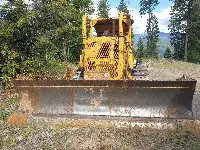
The pony engine clutch has never snapped into place on this machine. It has always had to be held. So I decided to see if it was adjustment.
I found the pin, pulled it out and rotated the spider. I ended up going quite a ways and still no snap, but it wouldn't turn anymore with the pin out.
I have been poring over the parts book diagram to see if I can figure out how it works, but there is only one reason I can think of for the spider not wanting to turn any more.
Can anybody with experience suggest a cause and solution?
Hi TOP, apologies if this is a stupid question but did you try adjusting in both directions? And how much of a turn did you make before retesting? Reason I ask is that often, it only takes a couple of pin holes to go from "won't snap-over" too loose to "won't snap over" too tight
I didn't do that yet.
ChatGPT did a deep search and found a discussion from 8 years ago that had some things to say. It goes along with what Old Magnet said.
"The first diagnostic move is not further tightening. It is to separate the clutch function from the pinion function, because on the 17A the upper and lower operating levers can be isolated by removing the block and nut in the control lever linkage. That lets you determine whether the clutch itself is failing to cam over, or whether the pinion/latch system is jamming or mispositioning the clutch linkage. ACMOC guidance for the 17A specifically recommends this split diagnosis."
I hadn't even thought about the pinion engagement mechanism interfering with the clutch engagement. So I am going to go out and look into that right now. It might take a while to get back on "separating the clutch and pinion function".
The clutch adjustment is a very fine line between no snap over when too tight or when too loose, as Neil said above.
More often than not regarding the adjustment one hole either way can give easy snap over and one more hole tighter gives difficult or no snap over--you will have to back the adjuster off and start from loose to find the sweet spot.
I would back the adjuster off and, with the clutch lever held in the engage position/direction, I would tighten the adjuster until I felt the clutch lever begin to push back against you --indicating the clutch is starting to engage --and then try for the sweet spot one hole at a time each way until the desired snap over is achieved.
If the adjustment at one hole more gives very difficult snap over use the looser setting.
Hope this helps,
Eddie B.
One of the things about adjusting this particular clutch is that getting the lock pin out of it's holes is real tricky. For what was suggested I kind of want to keep it out till I find the sweet spot and then release it to let it find the next hole.
silly thought for today is---maybe make up a suitable horseshoe shaped spacer that is light so the pin spring can hold it in place during your pre-setting procedure. Piece of copper pipe or such may work, or what ever you have at hand.
Cheers,
Eddie B.
silly thought for today is---maybe make up a suitable horseshoe shaped spacer that is light so the pin spring can hold it in place during your pre-setting procedure. Piece of copper pipe or such may work, or what ever you have at hand.
Cheers,
Eddie B.
That's what I was thinking too. Maybe I can 3D print one from a suitable material. I also thought of making it with a long handle so I can't accidentally drop it inside. That would be a disaster.
I will remove the block from the clutch lever too so I can manipulate just the clutch slider without involving the pinion actuator getting in the way.
"IF" there is a chance of dropping something into the "cavity" you might consider the age old fix - stuff the box full of rags. That has been around since the 1910's as those Model T Fords required the bands in transmission to be changed, easy to drop one of the nuts and end up pulling the "hogs head" to retrieve it. - cts
I solved the pickle fork problem and a way to prevent dropping things in.
A 3/8 box open end just fits over the pin and frees it up for turning without a hand on it. A screw driver can be used to get the pin out of it's hole and then just drop the open end over the pin and the other end rests on the side of the opening. Then bar the flywheel with a big screwdriver while the adjusting spider is stationary.
Since it is a box open end, the box end is tied to baling twine and the other end is looped over the clutch lever.
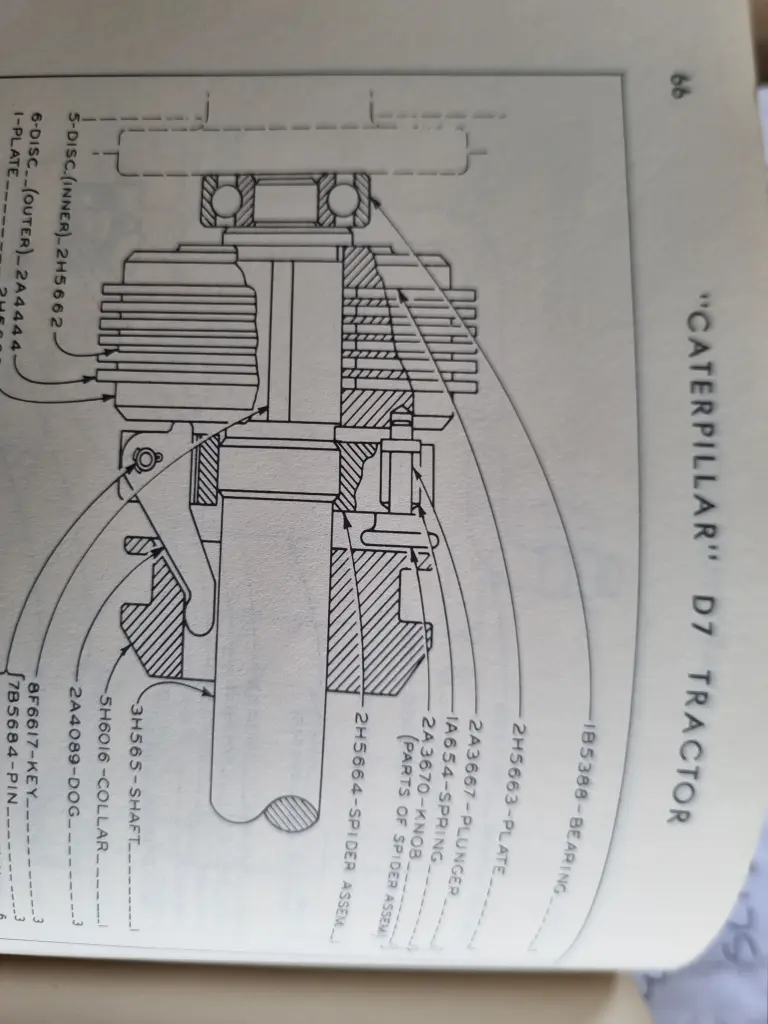
Now the issue is finding the spot where it will snap in. The adjuster was fully up against the clutch pack. I have been backing it off, but so far haven't found a spot that feels lt is close to a snap. Actually looking at the picture I may have spotted a mistake I was making. If I have the pin out of it's hole with the open end the clutch can never snap in because the pin will block the collar from traveling all the way to the clutch side.
The block in the pinion lever is being difficult to remove. Rusted into it's hole it seems.
After a frustrating afternoon of playing with the adjustment I found a spot that seemed like it was snapping in. But it wasn't very distinct. After testing it I may move it one more notch tight, but it now works better that it ever has.
The post mortem is that the previous owner(s) had it adjusted so that it was always engaged. This may have worn other parts of it an got it to it's present state. But the clutch holds with the setting I have but I have to lightly hold the lever to keep it there. The block is adjusted to get the most travel to the engaged direction. It is just old. Now when I start it the diesel doesn't turn untill I through it to engaged.
Thanks for all the ideas.
Things that helped:
Removing the block on the pinion lever to isolate the clutch from the pinion.
A good light to see inside.
The 3/8" open end pickle fork which held the pin out to allow making large adjustments.
An o-ring pick to help determine when and how much the pawls were engaged
The parts book diagram showing the relative positions of the collar and spider when engaged.
Patience
Glad to hear of your well deserved progress.


Our channel highlights machines from the earliest Holt and Best track-type tractors, equipment from the start of Caterpillar in 1925, up to units built in the mid-1960s.
Antique Caterpillar
Machinery Owners Club
1115 Madison St NE # 1117
Salem, OR 97301
Terms & Privacy
Website developed by
AdCo
"I also joined a year ago. had been on here a couple of times as a non-member and found the info very helpful so I got a one year subscription (not very expensive at all) to try it out. I really like all the resources on here so I just got a three year. I think its a very small price for what you can get out of this site."
-Jason N