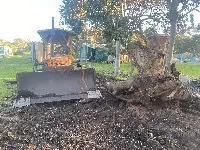

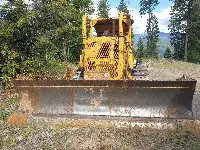
When I bought this machine it had a lot of bent and broken shoes. The rails, sprockets and rollers are all in quite good condition.
To solve this problem I was able to find used CAT shoes, but they had 3/4" bolt holes and the chain is made for 5/8" bolts. I gave some though to this and kind of reverse engineered how track shoes are held on.
I came to the conclusion that is is friction, not the bolt shank that holds the shoes in place. So the only thing that needs to happen is to correctly place the shoe on the chain during assembly and once torqued it shouldn't move.
So the experiment was to make plastic spacers that take up the space between the 5/8" bolt and the 3/4" hole in the shoe to center them on the chain till tightened. I bought CAT bolts and nuts for this to get the correct clamping forces and used the 2 flats torquing method to make sure they were good and tight.
I will let you know how this works out because track shoes are hard to find and this may open some possibilities up for people. I will go back over it with the torque wrench after running it every few hours for a while to see if they stay tight.
Hi TOP,
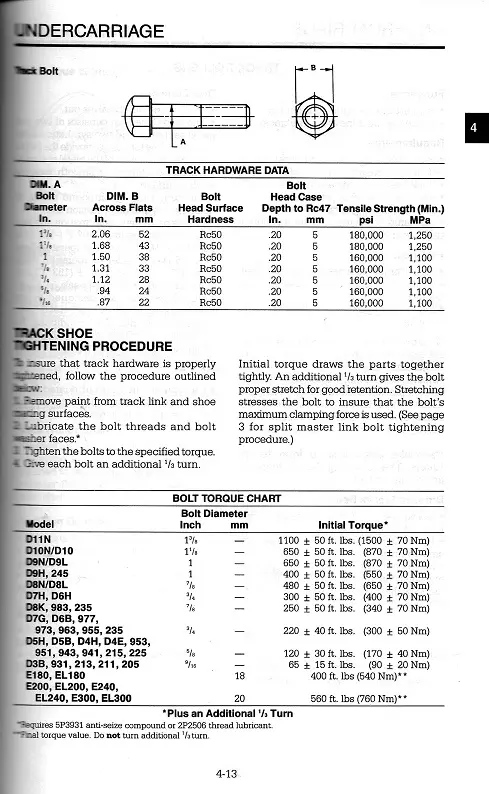
correct torque for 3/4" Cat Track Bolts is 220+/-40 ft/lbs. plus 1/3 of a turn, for clean surface plates/links with no paint no dirt etc.
Hope this helps from my old Caterpillar Parts Sales Kit Book, PEKP9100, printed 1989.
Cheers,
Eddie B.
Hi Eddie, would you happen to have the torque for D3 track bolts?
Track shoes/bolts to rail were all the same size as the hole in the rails. Any movement between the shoe and the bolt will eventually loosen, plastic bushings are a waste of time and effort, plastic is soft and will allow movement between the track shoe and the bolt. Lots of stress. Unless the track shoe has been damaged from loose bolts or cutting bolt heads, there should be no movement between bolt shank and the hole in the track shoe. Remember, stresses on track shoes are not equal from side to side depending upon conditions, that stress is directly taken by the bolts and transferred to the rail segment. - cts
Hi All,
as CTSF says track plate stresses can be such that at full power to just one single track plate if turning and that one side plate is sitting on a rock, steel deck or other immovable object so 4 bolts in poor fitting holes will most likely allow the plate to twist.
The shoe/chain bolts are sized to be snug fit in the chain and plate holes.
At the Dealer to drill out track plates we made up jigs to hold the track plates rigid and we used core drills or at a pinch masonry drills re-sharpened to drill out track plates and or rails with them clamped down in the jig
on a large radial drill but a cheap milling machine or a sturdy bench drill should get it done.
I was taught and religiously followed "Do it right once"
Track Bolt torques as requested as at 1989.
Cheers,
Eddie B.
Thanks very much, Eddie. Gee, 65 pounds plus a half turn doesn't seem like much for the D3B but that's what the book says so it's right. I have a new set of D3 chains for my D2 and it's the alligator link that I will need to torque when I install the tracks
Neil, Im sure the 1/2 turn after will make you wet yourself after how many to do?? on the D10/11 we had some pretty large tooling for the joiner link generally easier if we had 2 to do the torque with tooling (mostly to lift it in place)
I'm sure you're right Busso - just a bit strange to see that initial be so low. Although I only have four to do on each side and I have a multiplier to cheat with : )
HEY, WHOA UP THERE BOYS,
the track shoe torques are all the initial ft/lb torque PLUS "1/3" OF A TURN and NOT 1/2 as I can see would be easy to mistake--broken/stripped/over stretched bolts on the horizon.
If you open the scans in a new window and magnify them with the +, the 1/3 is clear enough.
My newer laptop has crashed and my steam driven Toshiba LT that MS crashed with dubious updates during Covid has been gently coaxed back from the dead over the intervening years and so scans are now not so clear on this LT for some reason.
Scans on 2" thick books are not easy to do!
The Cat Split Link bolt torques for the D3/931 are given as :- for 9/16" bolts, 65ft/lb + 1/2 turn--yes, these longer split link bolts are an extra 1/2 turn--gets confusing does it not.
Regards,
Eddie B.
Edb, yes it does get confusing, all those track links use different everything to say the least, we had cat trial tracks come thru the site due to massive wear factors (rails plates bushes pins) normally change tracks roughly 750 hrs if lucky to reach that far, remote dozers well didn't last as long as no operator no feeling, we had many different grouser plates due to aggressive wear some were thickness, height or metal make up to name what we tell putting them on, most of the time rails would come back with new plates occasional bush turn. At Boddington
Hi TOP,
correct torque for 3/4" Cat Track Bolts is 220+/-40 ft/lbs. plus 1/3 of a turn, for clean surface plates/links with no paint no dirt etc.
Hope this helps from my old Caterpillar Parts Sales Kit Book, PEKP9100, printed 1989.
Cheers,
Eddie B.
They are 5/8" bolts because the chain is 5/8". They have been torqued a lot higher than 220ftlbs. I used EDB's torque chart for 5/8" bolts. Initial torque was 150 ft/lb and then 1/3 a turn which got well over 300 ft/lb. Use CAT supplied bolts and thread lube. CAT track bolts are really cheap for what they are.
Although the chain rails are not very worn, the previous cheap after market shoes and their subsequent looseness messed with a lot of links. Eventually the chains will need replacing for that reason, otherwise not much wear.


Our channel highlights machines from the earliest Holt and Best track-type tractors, equipment from the start of Caterpillar in 1925, up to units built in the mid-1960s.
Antique Caterpillar
Machinery Owners Club
1115 Madison St NE # 1117
Salem, OR 97301
Terms & Privacy
Website developed by
AdCo
"I became a member recently because the wealth of knowledge here is priceless."
-Chris R