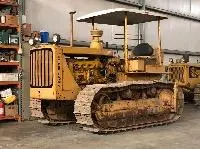
I've recently stumbled across an engine that I'm not entirely familiar with, a D320 with a turbo. It is on a genset that I am interested in acquiring; unsure how they faired in that application. Cute little bugger. Has to be the smallest authentic Caterpillar turbocharged engine that the company offered. In my eyes it appears to be a "modernized D2 engine" though suspect it was made long after tractor production stopped. I also wonder if any of the late D311s were offered with a turbo?
From what I can tell the D320 has same bore and stroke as a D311 though there are some visible differences (block, etc.). Can someone kindly provide a synopsis of their similarities and differences, why Caterpillar progressed to this series of engine, anything to watch out for, etc.? Does this family of engines have balance shafts like the “late” D315s (worked on one a couple of years ago in a Bucyrus cable shovel for a Mennonite friend so that’s relatively fresh in my head).
Sorry for all the questions. Most of my “hobby” work consists of that on alpine green or tan stuff. Time to become a scholar on (old) yellow iron. 😎
Thank you!!
We appreciate the questions. Nothing wrong with Detroits or old school Cummins. We have a local member (he doesn't get on computer much) that has been a Detroit Diesel mechanic since he got out of high school! Back to your comment regarding 320; I asked once why a person could not transplant one into a D2 and didn't really get any response. I wondered if some thought it was a larger engine than a 315 or 318 with that numeral! I believe a 320 was used in the 933 Traxcavator? Some of us will have to do some research for you!
I have only seen one turbocharged 311 in a D2, and it was an add-on. Rumor is it will be donated to our chapter!
I've thought about doing that to my 5U, JM. Mostly to shut it up but also because I think the layout lends itself to it - manifolds on different sides, plenty of room to turn the exhaust manifold down instead of up and hang the blower on the bottom, leaving enough room to route the exhaust pipe back up through the original hole in the hood. For the intake manifold, using the original air cleaner, a bracket arrangement that serves the structural support function of the original intake tube, with a fabricated tube exiting the air cleaner, flattened (and wide) over the top of the rocker cover to the turbocharger, then another fabricated tube from there back over the rocker cover to the intake manifold, using the opportunity to include an intake preheater sandwiched in
Hey Juice Man I wonder if I could get the name of your Detroit mechanic. I ve got some problems with just rebuilt 2 35 Detroit in a
435 John Deere. I need to talk to some one who knows. Would his phone number be available?? Would appreciate any help.
Claney


Our channel highlights machines from the earliest Holt and Best track-type tractors, equipment from the start of Caterpillar in 1925, up to units built in the mid-1960s.
Antique Caterpillar
Machinery Owners Club
1115 Madison St NE # 1117
Salem, OR 97301
Terms & Privacy
Website developed by
AdCo
"I also joined a year ago. had been on here a couple of times as a non-member and found the info very helpful so I got a one year subscription (not very expensive at all) to try it out. I really like all the resources on here so I just got a three year. I think its a very small price for what you can get out of this site."
-Jason N