

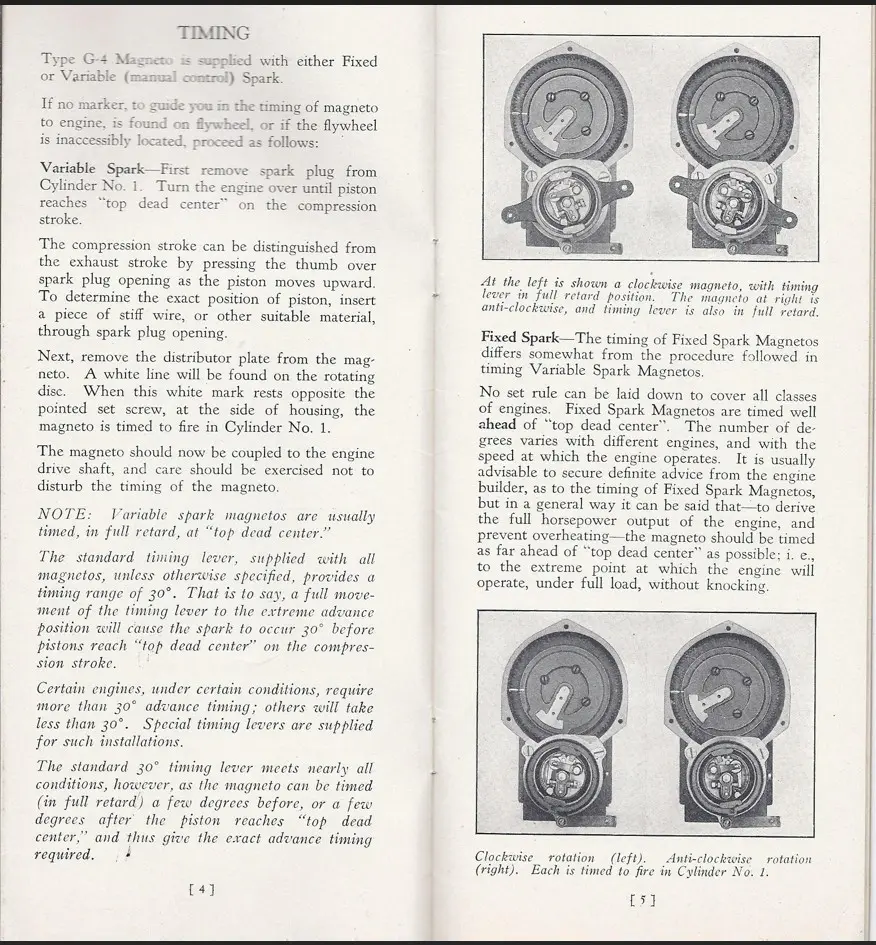
Caterpillar Ten getting hot. I bought the Ten without a mag and installed a G4 type 3 Eismann. It starts easy but gets hot pretty quickly. I think this page explains it all. My mag has the adjustable timing ring as shown. It hits the block and cannot be advanced. Yes I could move the timing or cut the lever off and wire the ring in one place, but I just cannot bring myself to do that. What parts are needed to convert the mag to stationary timing? Does conversion make sense? What came factory? If converted, will the mag retard to start and advance the timing once running? Too much advance equals a broken arm. Thanks for your thoughts. DG
Hi Grow, does the engine itself get hot or the mag? im not sure from reading the description you gave, I have no experience with a mag apart from knowing they give a good kick, I would think if you got it to run check timing of spark could be checked and if engine is getting hot maybe radiator clean out / inspection and check the water pump still has an impeller that pumps, I would check coolant system movement and operation unsure fan belt do drive properly and not there for a ride, Im sure a few more members will have much better knowledge of your machine and the mag set up, OM may gave some light on the mag.
The engine is getting hot. The head was machined flat and magnafluxed, new head gasket and studs.
No water in the oil. Nothing that points to compression getting to the cooling circuit. New belt with proper tension.
Water pump was taken off and inspected. Radiator was flushed. This weekend I have a pump to circulate cleaner through the block water passages. Everything points to timing. The thermostat is missing and I am on the hunt for that. The only odd thing is the top of the radiator was hot yet the bottom was cool. That being said there still may be a blockage somewhere. I do wonder if the water pump is off will a bore camera go the length of the block to look for crud? This has become a head scratcher. I will post my findings to help others.
I am no expert but how does the magneto timing make the engine hot? I grew up with a Model T Ford, spark was retarded to start and advanced as it was running, depending upon load, you advanced or retarded the spark. I never heard of it causing heating issues. I would be concerned about the radiator tubes, the passage from bottom of the radiator to the block and back through the system. I suspect there is a blockage. Let us know what you find and what you do to fix the problem. -- cts
If you can get a cheap temperature gun, use that to double check temps top and bottom of rad plus parts of engine, see if you have circulation in top of rad, if pump impeller is close you should get movement in top of rad, if to far away it will reduce movement, thermostat will govern movement until thermostat temp setting is reached then it will allow flow to rad (you will see movement) (yes you don't have thermostat/ regulator, if engine has not been started for some time they seem to get hot the first few starts then settle, if you are checking via temp gauges they run on a range of temp and can be out as I have found out in the past (new from box), most engines run roughly 10-15 degrees C different top to bottom of rad, basically warm coolant in to engine
Retarded timing can lead to overheating as well as power loss because the charge is still giving up energy in expansion later in the power stroke and even into the exhaust stroke in the worst cases.
Have you measured the actual timing value with a light? If not, do that because you want to know whether the timing is the problem, since another major "tuning" setting that can cause overheating is a lean mixture. But I agree with the other guys that since you suspect the temp difference between the top and bottom radiator tanks, measure it to figure out what it is. Ideally about 15 degrees so if you're getting 50 degrees, the problem is circulation (which is not to say that you don't have a timing and/or mixture problem but solve one issue at a time)
Hi, Grow.
I suspect that you may already have given the answer to your problem, and I quote:
"The only odd thing is the top of the radiator was hot yet the bottom was cool."
To my aging mind that indicates poor flow THROUGH the radiator. Yes, the bottom SHOULD be cooler than the top but only by about 10 to 15 degrees F. - which would still feel pretty warm to the touch at operating temperature, like maybe, for example, 185 F. at the top, down to maybe 170 F. at the bottom.
Your best bet might be, as Busso suggest, to get a cheap temperature sensing gun and check the water lines for temperature variations.
The thermostat's job is not to stop the engine overheating but rather to keep it up to operating temperature by opening or closing to regulate the water flow.
Just my 0.02.
You have a wonderful day. Best wishes. Deas Plant.
You may need to disassemble the radiator all together and see if there's any mouse houses in either tank. Then you could take a straight length of TIG welding wire or equivalent about 1/16" diameter and run it through every tube in the radiator core. There could be some small crap built up in the tubes. Most of the radiators I've encountered have had that sort of junk laying on the top and bottom from sitting many years.
Hi Team,
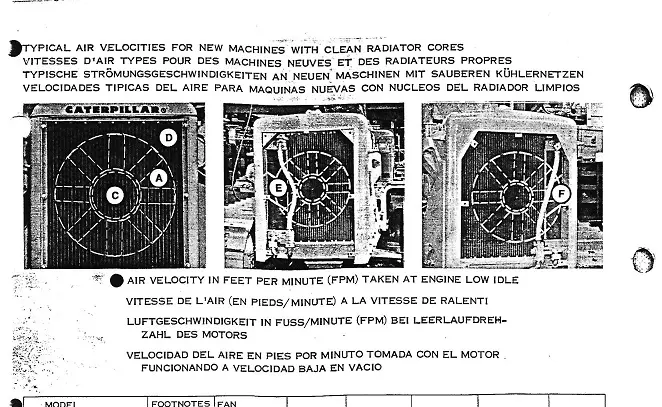
also suggest putting a shop light or such behind the radiator core and look thru the core from the front to see if the fins are clogged with dust--you will need to move the light from radiator section to another--if the air cannot pass thru the fins it cannot cool the coolant in the tubes.
Seems something went wrong with my image posting and this was not an image I wanted, maybe things have changed since I was last here--sorry.
The posted image gives you and idea where are velocities vary over the core face.
Cheers,
Eddie B.
Another item to check - on the Thirty I owned, the fan had a fiber disc that acted as a friction plate, it was allowing the fan to slip. - cts
Good to hear from you Eddie.


Our channel highlights machines from the earliest Holt and Best track-type tractors, equipment from the start of Caterpillar in 1925, up to units built in the mid-1960s.
Antique Caterpillar
Machinery Owners Club
1115 Madison St NE # 1117
Salem, OR 97301
Terms & Privacy
Website developed by
AdCo
"I became a member recently because the wealth of knowledge here is priceless."
-Chris R