

Bruce P. Thanks, yet again, another idea. I do have a pressure washer. A stout one at that, so throttling it would definitely be in order to be careful, as you suggest. Mine, like yours, has a vertical dent to the right-hand side that also looks like a log or standing tree did the work.
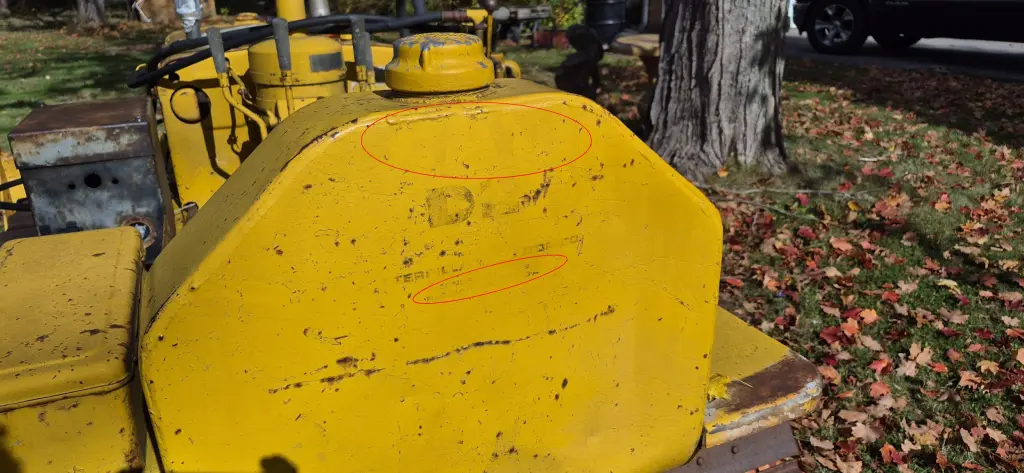
As a complete adjunct subject on this tank...First, I apologize if I should have started a new thread. I'm learning the forum. Last night I received my copy of "Caterpillar D-2 & R-2 Photo Archive" and studied each page, of course, paying attention to decals and fonts. If you study the photo I've attached, the tank shows a one-time paint, over what was the original lettering. In all the pics of D2's I've looked at, and the pics in the book, I didn't see one that said "General Offices" (see the bottom red oval). Perhaps I've missed it, and you've seen it elsewhere. Also, in a very ghostly hue (you have to look close), you can see a larger "CAT" image above "D2" in the same font. The unit is 5U2580, which puts it in early 1949.
Found it interesting. Please correct me if others have seen this decal configuration and again, thanks for all the comments on the tank.
Chris
This is thinking outside the box, using your gray matter to the best advantage trying to eliminate the explosive force by igniting the residual fuels. BUT how are you going to regulate the pressures provided by a mechanically driven pump? How do you monitor the pressures, observe the results, and then relieve those kinetic forces of pressure? Are you not trading one potential explosive failure for another? You are venturing into the realm of producing a "bomb". Not a lot different, "bombs" are the results of over pressurization of the containment vessel! Over pressurization of any containment vessel has been and always will be a dangerous situation, especially with unknown thickness and material weak spots. Engineers design and test pressure vessels to rigid standards and those are subjected to testing at periodic intervals. The fuel tanks on the Cats were not designed or made as pressure vessels and as such, they are not intended to withstand pressure other than static from weights of the contents. Any wrinkle or dent will have to a degree, higher resistance to flex than a flat sheet. Realistically, what is that dent worth to you and your loved ones? - STAY SAFE -- cts


Our channel highlights machines from the earliest Holt and Best track-type tractors, equipment from the start of Caterpillar in 1925, up to units built in the mid-1960s.
Chapter Eighteen
| Allora, South-East Queensland
Antique Caterpillar
Machinery Owners Club
1115 Madison St NE # 1117
Salem, OR 97301
Terms & Privacy
Website developed by
AdCo
"I became a member recently because the wealth of knowledge here is priceless."
-Chris R