

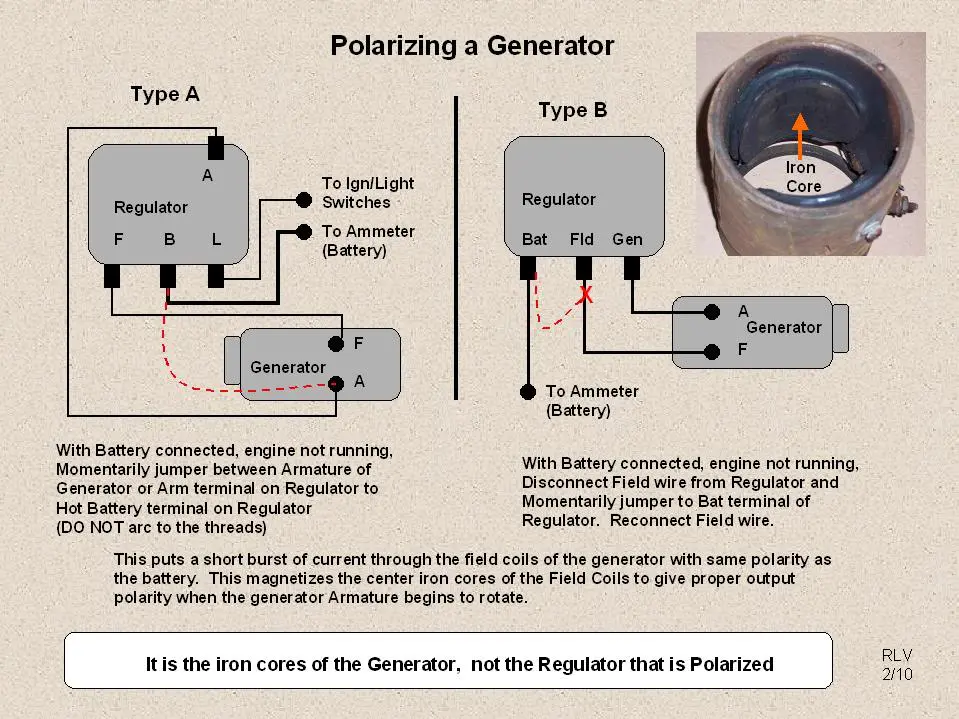
Is it an American Bosch (type 😎 generator
or a Delco Remy (type A)?
They use a different method of polarizing.
Don't know why I'm getting that image, should read (type 😎
Type A or B
Doing it wrong can cause damage
[attachment=66263]Polarizinggenerator.jpg[/attachment]
It's got a Delco tag on it but can't make out all the numbers on it for ID
Do a motor test on the generator.
Remove generator and power armature terminal and ground the case. Should run as a motor.
I’ll try that tomorrow. Thanks for the help!!
If it runs as a motor the armature, brushes and commutator are probably ok.
While running as motor ground the field and if the motor slows down some the fields should also be ok.
If it runs as a motor the armature, brushes and commutator are probably ok.
While running as motor ground the field and if the motor slows down some the fields should also be ok.
[quote="Old Magnet post=234822 "]If it runs as a motor the armature, brushes and commutator are probably ok.
While running as motor ground the field and if the motor slows down some the fields should also be ok.
[/quote]
Old Magnet again you come through with flying colors ...and explained not only where but why and how to do the tests and when.
That is the exact question I was going to ask next.. THANKX I blazed through the service manual a few days ago and saw that a bad connection in the charging system anywhere can cause the generator not to be able to reach its max potential (paraphrased) . It also suggested cleaning the connections after setting for a long time.That is where I was headed next but now I have more ammo to pinpoint and attack the charging issue.
That was worth the $50 I paid for the ACMOC subscription just in that one topic... again thanks.
I tested the generator today. It would run like a motor if you would help it get started. Ground the field terminal and it will slow down. Does that sound rite??
That's what it should do. Problem is not with the generator.
Remount the generator and with tractor running, temporarily ground the generators field post to the case. If it charges then (make sure you have a working ammeter) the voltage regular may be bad or a wire is missing from the field post to the field terminal in the voltage regulator or the VR is not well grounded.
If it still doesn't charge, leave the field grounded and jump a wire across the VR's Bat and Arm terminals. (this bypasses the cutout relay). If it now charges the VR's cutout relay isn't working correctly. (maybe points burned/carboned/resistive.
With those two steps you basically by pass the VR functions so if it still won't charge you're left with a bad battery or wiring issue other than the generator itself which you have just tested.


Our channel highlights machines from the earliest Holt and Best track-type tractors, equipment from the start of Caterpillar in 1925, up to units built in the mid-1960s.
Chapter Two
| Folds Farm, Godshillwood, Fordingbridge, Hampshire, SP6 2LU
Antique Caterpillar
Machinery Owners Club
1115 Madison St NE # 1117
Salem, OR 97301
Terms & Privacy
Website developed by
AdCo
"I also joined a year ago. had been on here a couple of times as a non-member and found the info very helpful so I got a one year subscription (not very expensive at all) to try it out. I really like all the resources on here so I just got a three year. I think its a very small price for what you can get out of this site."
-Jason N