
Hello to anyone taking the time to read this post!
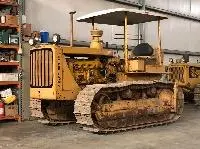
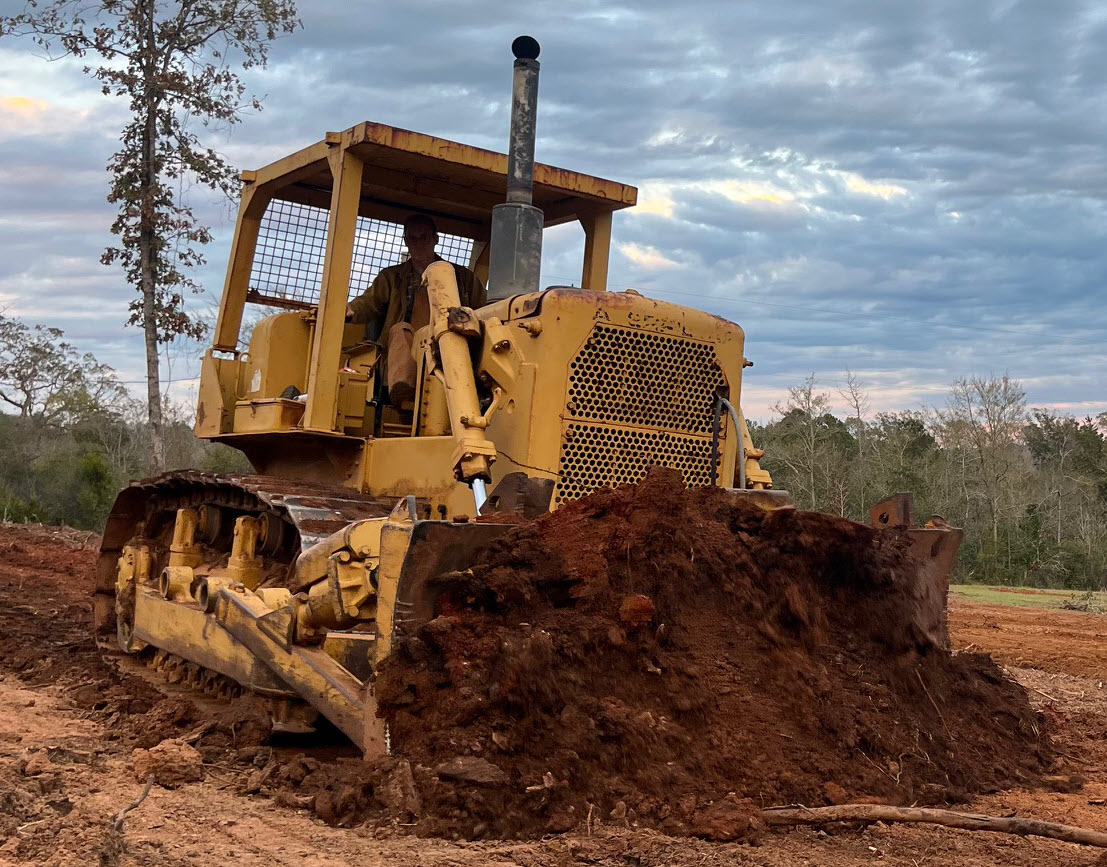
I have a 1966 Cat D6C dozer that was manufactured in Japan. The final drive on one side leaks when filled up, while the other side has zero leaks and maintains a consistent fluid level. I'd like to stop the leak and was curious if there are any solutions I should try before taking the whole final drive apart?
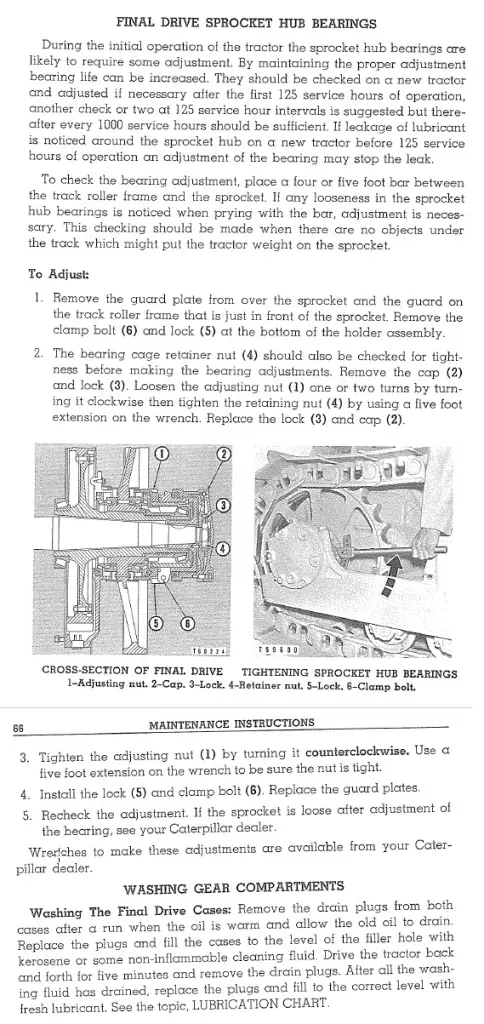
In the Ops and MTCE manual, there's a section on "Final Drive Sprocket Hub Bearings" that mentions adjusting the bearings may stop a leak. I'll attach a picture of the page for reference. The procedure mentions using a 4-5 foot bar between the track roller frame and the sprocket to check for movement—if there's play, adjustment is necessary. It goes on to say, "This checking should be made when there are no objects under the track which might put the tractor weight on the sprocket." Does this mean the tractor needs to be jacked up on that side?
Any insight or advice would be greatly appreciated!
1966 D6C
Hi, Jprice1101.
On flat ground there is no actual weight on the sprocket as the rim of the sprocket is far enough above the ground level by design that it can't transfer any weight to the ground via the track chain.
If you have any doubts about it, place a small block about 2" thick on the ground and back the tractor up onto the block until the rear bottom track roller is directly over the block.
Hope this helps.
Just my 0.02.
You have a wonderful day. Best wishes. Deas Plant.
Thank you Deas, I appreciate the advice.
Is there a special tool needed to tighten the hub bearing? I didn't find any mention of one in the book, but the picture shows a unique looking "wrench". Almost like a very large spanner wrench.
Thanks!
1966 D6C
Hi, Jprice1101.
I think it is like a large collett wrench but don't quote me. Other than that, a good punch and a hammer might do the trick, although wouldn't give you much idea of what torque was being applied - and I suspect that there might be a torque spec. for it.
Just my 0.02.
You have a wonderful day. Best wishes. Deas Plant.
Thank you Deas, I think you are under selling yourself. So far you have provided more than 0.02 worth!
1966 D6C
Hook spanner wrench might be a term that works. OTC Tools 7308 Adjustable Hook Spanner Wrench W/2 Interchangeable Jaws - Search Shopping
As close as I can come with google.
Most of the finals on the Cats from the 50's have a bit of a leak. No big deal if it leaks it has fluid inside. The owner of a D4D told me don't do that with a next generation of Cats. See a leak take it out of use and it might only be one bearing and a seal. Run the D4 D a few more days and you could figure most everything needs to be replaced inside. Was he just unlucky? Or are the 60' to 80's Cats all like this?
It will hold fluid, but if you fill it up more than about half it will leak out. I found that out when I first got the tractor on site and was replacing all the fluids. Made a bit of a mess, but I knew it had as much fluid as it would hole.
If I am operating it on a slope/incline of course that causes a loss of fluid too. I just wanted to see if anyone had had any luck at stoping a leak by doing the adjustment in the picture I attached. I don't have that big of a "spanner wrench" and if there is no chance of it helping I would not make the purchase.
The price of the one Ray sent a ling to is more than $250. I can buy a large quantity of oil for $250!
1966 D6C
As much as I don't wish to make this suggestion; some folks fill with 00 track lube to slow it down, but your leak sounds like it needs immediate attention.
My own thoughts are to check the tension, tighten up (hopefully not too much needed). Excessive slop would be a bad bearing(s)? Add the track lube and watch closely. This might get you by until you have the proper tools and time to make needed repair. JM
For spanner wrenches, you can cut them out of a sheet of 1/4 (or whatever is the max thickness that will enable the tooth to engage) mild steel, or you can use the engaging lug from an existing spanner wrench and make up the appropriate radius out of a sheet of 1/4. The weakest point would be the tooth
a quick dirty field adjustment for a loose final drive bearing can be to use a large crowbar to lever around the castellated nut as far as you can in the direction indicated after removing the castellated nut lock. The lock is clamped by a long 1/2" bolt which clamps the outer hub onto the inner hub in service.
The usual torque was a 100 lb man on a 5 foot pipe on the correct wrench or around 500lb/ft.
This action should allow you to check if you need to investigate further if the oil loss is not stemmed after a short time of operating. If all is good then you need to do the preload correctly.
Your experience may vary.
Cheers,
Eddie B.


Our channel highlights machines from the earliest Holt and Best track-type tractors, equipment from the start of Caterpillar in 1925, up to units built in the mid-1960s.
Chapter Nineteen
| 1200 Ferntree Gully Rd, Scoresby VictoriaChapter Nineteen
| 5875 South Gippsland Hwy, Nyora, VictoriaChapter Nineteen
| 80 Chapman Rd, Silvan, VictoriaChapter Thirty
| Booleroo Centre, 54 Arthur St, Booleroo Centre SA 5482, Australia
Antique Caterpillar
Machinery Owners Club
1115 Madison St NE # 1117
Salem, OR 97301
Terms & Privacy
Website developed by
AdCo
"I also joined a year ago. had been on here a couple of times as a non-member and found the info very helpful so I got a one year subscription (not very expensive at all) to try it out. I really like all the resources on here so I just got a three year. I think its a very small price for what you can get out of this site."
-Jason N